
Quick Facts About Opossums
The Virginia opossum (Didelphis virginiana) holds a unique distinction in North American wildlife: it is the only marsupial native to the United States and Canada. This ancient mammal, commonly referred to simply as “possum” throughout much of its range, has survived virtually unchanged for millions of years while adapting remarkably well to modern landscapes.
At a Glance:
Size: Similar to a house cat, typically 4–12 pounds and 15–20 inches body length
Appearance: Coarse gray or blackish fur, white face, pink nose, dark round ears
Tail: Long, hairless prehensile tail used for balance and gripping
Teeth: 50 teeth—more than any other North American land mammal
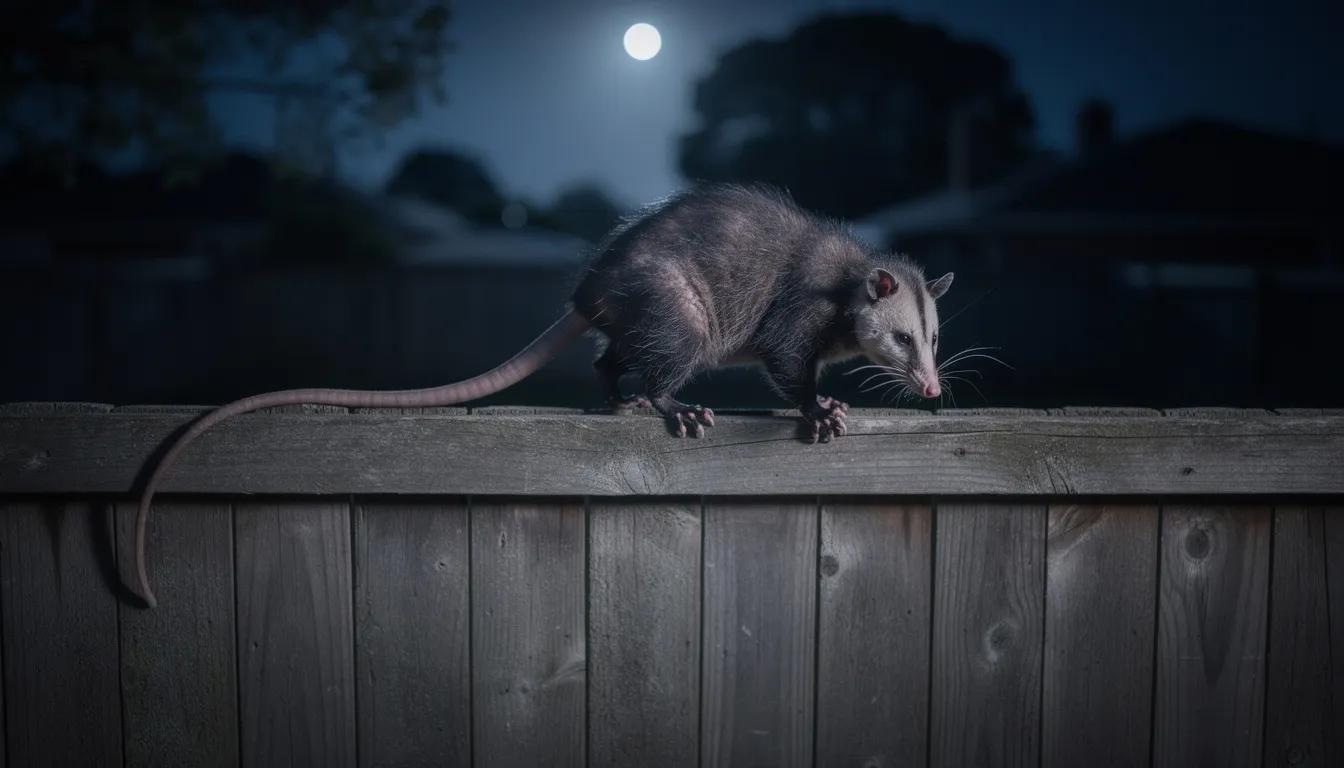
Activity: Primarily nocturnal opossum behavior, with peak foraging after dark
Diet: Omnivorous, eating insects, snails, carrion, fruit, and opportunistically pet food
Geographic Range:
The Virginia opossum ranges from Costa Rica through Mexico into the eastern and central United States, extending northward into southern Ontario, Canada. The species was introduced to California near San Jose around 1910, subsequently spreading throughout much of the state and into the Pacific Northwest.
Signature Behaviors:
These solitary animals are best known for their nocturnal lifestyle, opportunistic omnivorous diet, and the famous defense mechanism called “playing possum”—an involuntary, fainting-like response triggered when the animal faces extreme threat. This isn’t a conscious trick but rather an automatic physiological reaction that can last from minutes to several hours.
Biology, Identification, and Behavior
Before diving deeper, it’s worth clarifying a common point of confusion: the “opossums” of the Americas belong to an entirely different group than the “true possums” of Australia and New Zealand. While both are marsupials, they’re separated by millions of years of evolution and an ocean. This article focuses exclusively on the Virginia opossum of North America.
Physical Appearance
The Virginia opossum presents a distinctive silhouette. Its coarse outer fur ranges from grayish-white to nearly black, while the face remains predominantly white with a pointed snout and that characteristic pink nose. The ears are dark, rounded, and largely hairless—vulnerable to frostbite in northern climates. Adults typically weigh between 4 and 12 pounds, with males generally larger than female opossums.
The tail deserves special mention. Unlike the bushy tails of raccoons or squirrels, the opossum’s prehensile tail is nearly naked, scaly in appearance, and highly functional. Young opossums can use it to hang upside down briefly, though adults are generally too heavy for this. More practically, the tail serves for balance when climbing trees and can even help carry nesting material back to dens.
Key Anatomical Features:
Opposable big toe on hind feet (no claw), functioning like a thumb for grasping tree limbs
50 sharp teeth arranged for processing diverse foods—from insects to overripe fruit
Marsupial pouch on females where underdeveloped newborns complete their development
Relatively low body temperature compared to other mammals (around 94–97°F)
Daily and Seasonal Behavior
Opossums are strictly or mostly nocturnal, venturing out after dark to forage and returning to shelter before dawn. Their movement is slow and deliberate rather than quick—they’re walkers, not sprinters. Despite their lumbering gait on the ground, they’re surprisingly capable at climbing trees and can swim when necessary.
During daylight hours, opossums rest in various denning sites: tree cavities, brush piles, abandoned burrows dug by other animals, culverts, rock crevices, or spaces under sheds, decks, and porches. Unlike many wild mammals, opossums don’t hibernate. They may reduce activity during severe cold snaps, sometimes remaining in dens for short periods, but they continue foraging throughout winter. Their hairless ears and tails make them vulnerable to frostbite in northern regions.
Diet and Foraging
The opossum’s 50 teeth aren’t just for show—they enable an impressively varied diet. These omnivores consume:
Insects (beetles, cockroaches, crickets)
Snails, slugs, and earthworms
Carrion found on roadsides and in fields
Fallen fruit, berries, and garden vegetables
Small mammals like mice and voles
Bird eggs and nestlings
Frogs, crayfish, and small snakes
Pet food, garbage, and compost when accessible
Their habit of eating snails and slugs makes them valuable garden allies, and studies suggest opossums may help reduce tick populations in areas they frequent. One often-cited estimate suggests individual opossums can consume thousands of ticks seasonally, though the overall impact on tick-borne diseases like Lyme disease remains under investigation.
The “Playing Possum” Response
When severely threatened and escape seems impossible, opossums may enter an involuntary catatonic state—the famous “playing possum” or play dead response. This isn’t a conscious decision but rather an automatic physiological reaction, similar to fainting under extreme stress.
During this state, the animal:
Falls onto its side with eyes open or partially closed
Becomes stiff and unresponsive
Lets its tongue hang out
May foam at the mouth
Secretes a foul-smelling greenish fluid from anal glands, mimicking the odor of decay
This response can last anywhere from a few minutes to several hours. For predators that prefer live prey or respond primarily to movement, a “dead” opossum loses its appeal as a meal.
Intelligence
Despite their reputation, opossums are far from stupid. Research involving maze navigation and discrimination tests has shown opossums performing as well as or better than dogs and pigs on certain cognitive tasks. They demonstrate good memory for food locations and learn to avoid threats effectively. Their cautious, slow-moving nature is a survival strategy, not a sign of limited intelligence.

Life History and Reproduction
Compared to other wild mammals of similar size, opossums live remarkably short lives. In the wild, most individuals survive only 1–2 years, with few reaching 3–4 years. This brief lifespan is offset by early sexual maturity and high reproductive output—a classic “fast” life-history strategy.
Breeding Season and Reproduction
In most of the United States, the breeding season begins in late winter (January–February), with females potentially producing a second litter in late spring (May–June) in warmer regions. Some southern populations may even manage three litters annually.
The reproductive process highlights the opossum’s marsupial heritage:
Mating: Males locate receptive females primarily by scent
Gestation: Remarkably brief at only 12–13 days—among the shortest of any mammal
Birth: Female opossums give birth to 10–20 tiny, underdeveloped young, each barely larger than a honeybee
Competition: Newborns must immediately crawl unaided to the mother’s pouch; only those that find and attach to a nipple survive
Nipple limitation: With usually only 13 nipples available, litter survival is capped regardless of birth numbers
Development Stages
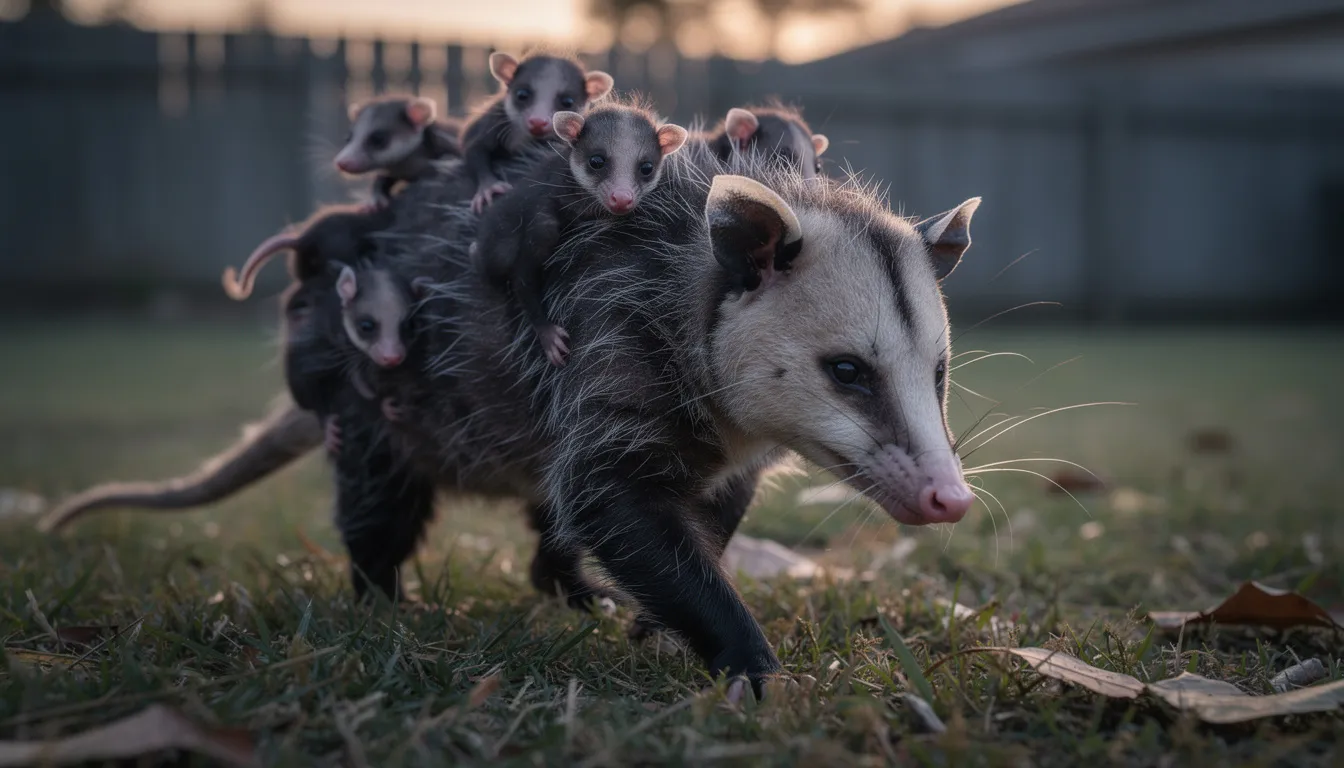
After the perilous journey to the mother’s pouch, surviving young crawl inside and attach firmly to a nipple, where they remain for approximately 7–8 weeks. During this time, they complete the development that occurs in utero for placental mammals—growing fur, opening their eyes, and developing limbs.
Developmental Timeline:
Stage | Timeframe | Key Developments |
|---|---|---|
Birth | Day 1 | Bean-sized, blind, mostly limbless |
Pouch attachment | Weeks 1–8 | Continuous nursing, organ development |
Venturing out | Weeks 9–12 | Riding on mother’s back, learning to forage |
Weaning | ~3 months | Beginning to eat solid food |
Independence | 3–4 months | Dispersal from mother |
Sexually mature | 8–12 months | Capable of breeding |
Social Structure
Adult opossums are fundamentally solitary animals. Outside of mating encounters and the period when females are raising young opossums, adults rarely interact. Home ranges overlap without territorial defense, and multiple individuals may use the same den sites at different times. This solitary nature, combined with their nocturnal habits, means most people never see the opossums living nearby—even when populations are healthy.
Habitat, Range, and Human Encounters
Opossums thrive in edge environments—those transitional zones where different habitat types meet. Think wooded borders along fields, brushy stream corridors, hedgerows between properties, and the patchwork of yards, gardens, and green spaces that characterize suburban areas and urban areas alike. Access to water and dense cover increases habitat suitability.
Historical and Current Range
The Virginia opossum’s range has expanded significantly over the past century. Originally concentrated in the eastern and central United States, Mexico, and Central America, populations have pushed steadily northward into New England, the Great Lakes region, and southern Canada. Climate warming and human land modification have facilitated this expansion.
The Pacific Coast population traces to intentional or accidental introductions near San Jose, California, around 1910. From this starting point, opossums spread throughout much of California and into Oregon, Washington, and British Columbia, demonstrating their adaptability to new environments.
Denning Sites
Opossums don’t dig their own burrows but readily occupy shelters created by other animals or circumstances:
Abandoned burrows of groundhogs, skunks, or foxes
Hollow logs and tree cavities
Brush piles and dense shrub thickets
Rock crevices and culverts
Crawl spaces under houses, sheds, porches, and decks
Attics accessed via overhanging tree limbs or gaps in soffits
Garages and outbuildings with open doors
They may use multiple dens within their home range, switching locations every few days and rarely staying in one spot for long.
Why Opossums Thrive Near People
Residential areas offer opossums a buffet of food sources and shelter options that may exceed what’s available in purely wild habitats:
Garbage cans and open compost piles provide easy calories
Cat food or dog food left outside at night attracts foraging opossums
Fruit trees drop accessible meals
Bird feeders spill seed that attracts both prey (mice) and direct consumption
Ornamental gardens harbor insects, snails, and soft fruits
Sheds, decks, and porches offer ready-made denning sites
Reduced predator pressure compared to rural areas
Signs of Opossum Presence
How do you know if opossums are visiting your property? Watch for these indicators:
Pet food disappearing from outdoor bowls overnight
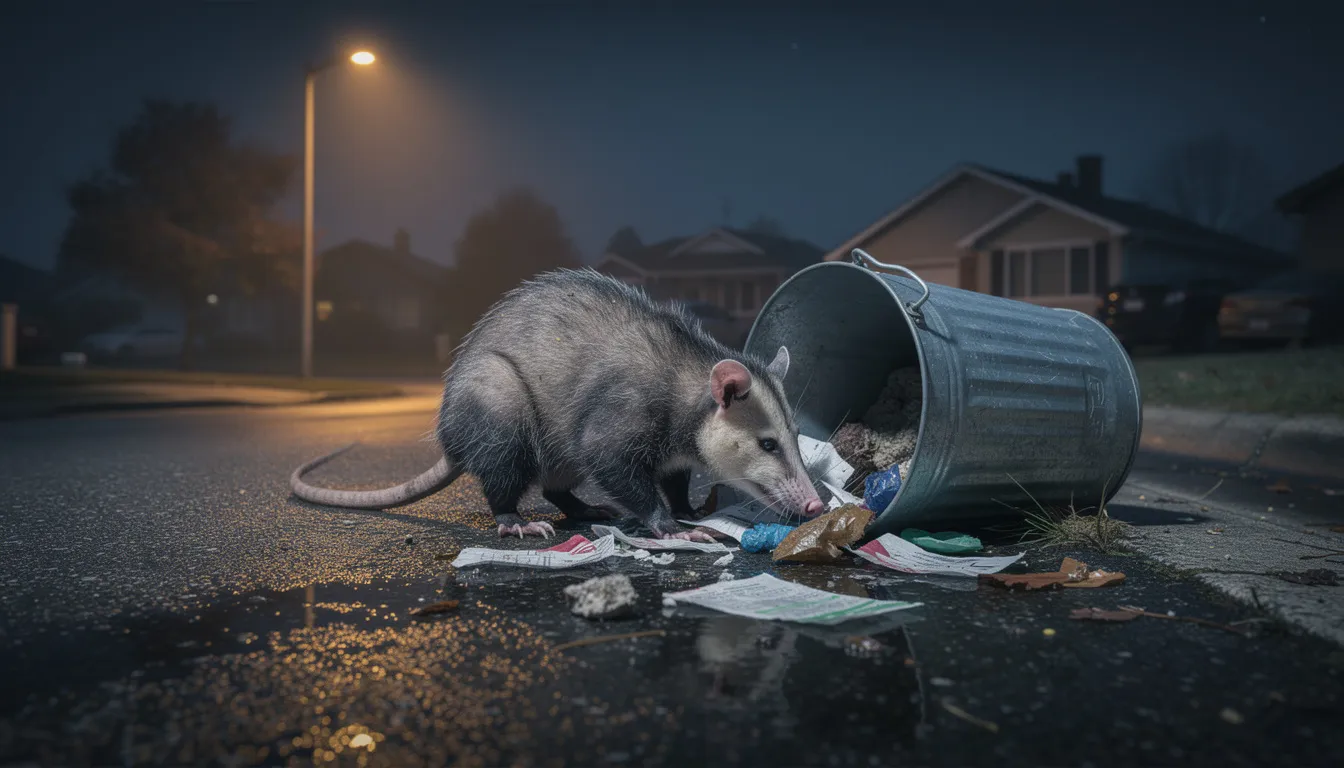
Garbage scattered from containers with loose lids
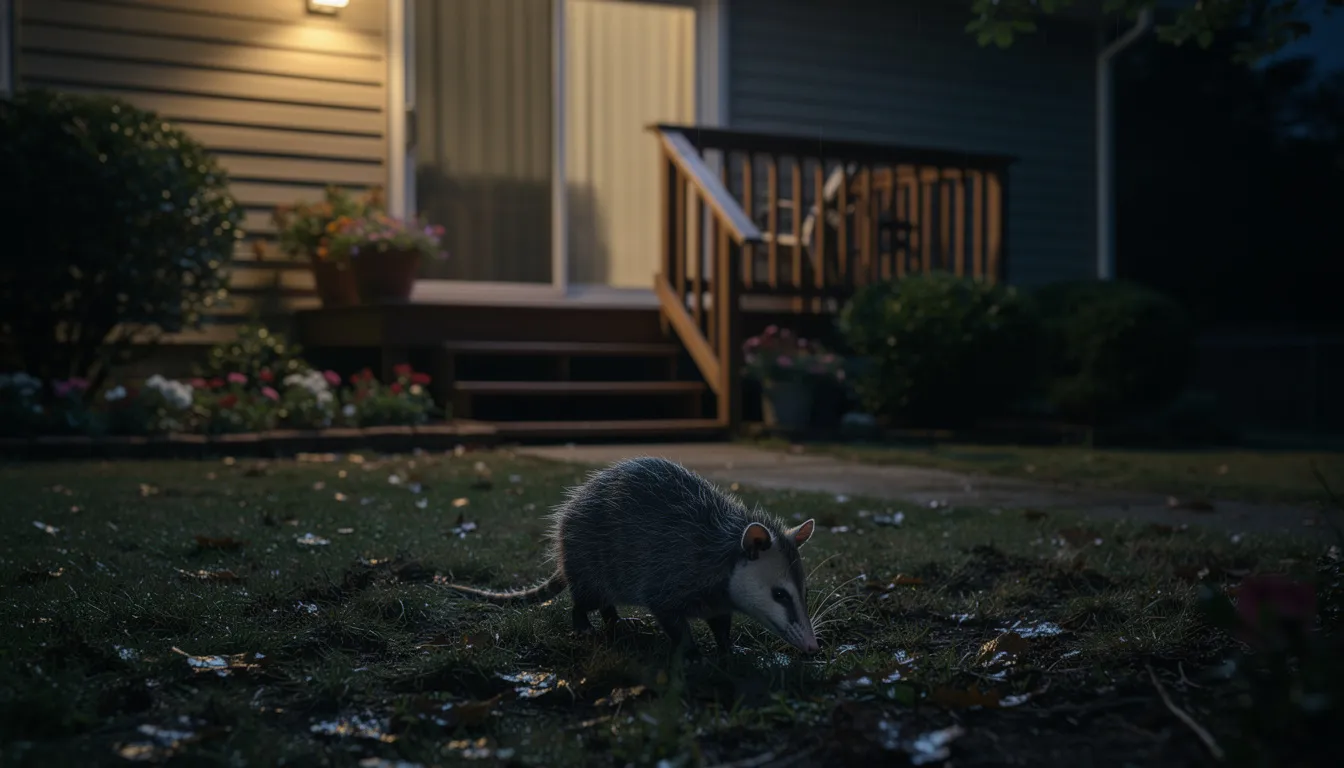
Nocturnal rustling, scratching, or shuffling sounds under structures
Droppings near den entrances (similar in size to cat feces, often containing insect parts)
Muddy footprints showing the distinctive opposable hind toe
Occasional nighttime sightings of adults or young opossums near exterior lights
Pets showing unusual interest in specific areas of the yard
Benefits, Risks, and Public Health Concerns
Opossums occupy an interesting middle ground in human-wildlife relations. They’re neither particularly dangerous nor entirely benign—mostly, they’re just trying to make a living like any other wildlife species. Understanding both sides of the ledger helps homeowners respond appropriately.
Ecological and Practical Benefits
Why opossums make good neighbors:
They consume enormous quantities of insects, including cockroaches, beetles, and garden pests
Their appetite for snails and slugs benefits gardeners without chemical pesticides
As scavengers, they clean up carrion from roadsides, fields, and yards—nature’s sanitation crew
They eat fallen and overripe fruit before it rots and attracts other animals
They prey on mice and rats, helping control small mammals around homes
Studies suggest they may reduce tick survival in their territories, potentially lowering exposure to tick-borne diseases
They consume venomous snakes like pit vipers, showing notable resistance to their venom
Nuisance Issues
When opossums cause problems:
Raiding unsecured garbage cans and tipping over containers with loose lids
Eating garden produce, particularly ground-level vegetables and berries
Taking chicken eggs or occasionally killing small poultry
Denning under decks, in sheds, or in crawl spaces, creating noise and odor
Getting into open compost piles and scattering material
Entering garages or homes through a pet door left open at night
Occasionally eating ornamental fish from shallow garden ponds
These behaviors are typically opportunistic rather than targeted—opossums exploit available resources rather than seeking out conflict with humans or pets.
Disease and Health Concerns
Like all wild mammals, opossums can carry parasites and pathogens. Context matters: actual transmission to humans is uncommon with basic hygiene and common sense.
Organisms of concern:
Leptospirosis: Bacterial infection transmitted through contaminated urine; risk managed by avoiding contact with opossum waste
Salmonella: Potential transmission through fecal contamination of food or surfaces
Sarcocystis neurona: Parasite that causes equine protozoal myeloencephalitis (EPM) in horses; transmitted when horses ingest feed or water contaminated with opossum feces
External parasites: Fleas and ticks carried on opossums may transfer to pets
Rabies: The Facts
Despite common fears, rabies in opossums is extremely rare. Documented cases occur far less frequently than in raccoons, skunks, foxes, or bats. Scientists hypothesize that their relatively low body temperature compared to other warm blooded animals creates an unfavorable environment for the rabies virus to replicate.
That said, opossums are not immune—they can contract rabies under some circumstances. However, the open-mouthed hissing, drooling, and defensive posturing that often alarms people is not a sign of rabies but rather normal threat behavior. An opossum that appears disoriented, aggressive without provocation, or active during daylight with no apparent reason warrants caution and a call to local wildlife authorities.
Safety Guidelines
Never attempt to handle wild opossums—they will bite if cornered
Keep dogs and other pets vaccinated against rabies
Do not allow pets to harass, attack dogs, or corner opossums
Contact local wildlife or animal control agencies for injured, disoriented, or unusually aggressive animals
Horse owners should prevent opossums from accessing feed storage and water sources
Living With and Managing Opossums
Managing opossum presence ranges from simple coexistence at one end to regulated removal at the other. For most homeowners, prevention and minor exclusion solve the vast majority of issues without ever needing to trap or relocate animals. Before taking any management action, note that legal status varies: opossums may be classified as furbearers, nongame species, or protected wildlife depending on your state or province.
Prevention for Homeowners
Food source management:
Remove pet food bowls from outdoors before nightfall—don’t attract opossums with free meals
Use garbage cans with tight fitting lids; consider securing with bungee cords if necessary
Clean up fallen fruit regularly from beneath trees
Compost in enclosed bins rather than open compost piles
Bring bird feeders in at night or use feeders that minimize seed spillage
Store livestock and chicken feed in sealed containers
Install hardware cloth around chicken coops and cover runs
Habitat modification:
Trim tree branches at least 5 feet away from rooflines to prevent opossums from accessing attics
Remove or reduce brush piles near buildings
Stack firewood away from structures and off the ground
Clear debris and clutter that provides hiding spots
Close garage doors and seal pet door access at night
Exclusion Techniques
When opossums have established themselves under a deck, in a shed, or in other unwanted locations, exclusion after departure works better than trapping:
Confirm activity patterns: Sprinkle flour near suspected entry points to track footprints and determine when the animal inside leaves
Wait for departure: Opossums typically leave their dens after dark to forage
Install temporary barriers: Loosely block entrances with newspaper or light debris—if pushed aside the next morning, the animal is still using the site
Seal permanently: Once you confirm the opossum has left, install permanent barriers using hardware cloth, solid boards, or commercial excluders
One-way doors: For complex situations, one-way excluder doors allow animals to exit but prevent re-entry
Screen all vents, crawl space openings, and soffit gaps with 1/4-inch hardware cloth. Bury exclusion barriers 6–12 inches deep around decks and porches where animals might dig.
Handling Specific Conflicts
Opossum in garage or house:
Close interior doors to limit movement
Open exterior doors and windows to provide escape routes
Turn off interior lights and turn on exterior lights to guide the animal outside
Use a broom or large towel as a visual barrier to gently encourage movement toward exits
Avoid cornering—opossums may bite or enter a catatonic state when trapped
For a short while, patience usually works; the opossum will find its way out
Opossum in chicken coop:
Install predator-proof fencing and hardware cloth on all openings
Collect eggs daily to remove attractants
Ensure coop doors close securely at night
Use motion-activated lights or sprinklers as deterrents
Concerns about horse barn access:
Store feed in sealed metal containers
Prevent opossums from denning in hay storage areas
Cover water troughs when possible
Consult your veterinarian about EPM prevention if opossums are frequent visitors
Legal Considerations
Before trapping, relocating, or lethally removing opossums, check your local regulations:
Classification varies (furbearer, nongame, protected species)
Trapping may require permits or be restricted to certain seasons
Relocation is prohibited in many jurisdictions due to disease transmission concerns
Lethal control methods like drowning or poisoning are illegal in most areas
Some states protect opossums from unlicensed killing entirely
Contact your state wildlife agency, department of natural resources, or local animal control office for current regulations.
When to Call Professionals
For complex situations—opossums in wall voids, large numbers of animals under structures, or animals that won’t leave despite exclusion efforts—consider hiring a certified wildlife control operator. These professionals understand local regulations, have appropriate equipment, and can implement solutions efficiently.
If you attempt live trapping yourself, use appropriately sized cage traps (roughly 10 × 12 × 32 inches) baited with cat food, hard-boiled eggs, or fruit. Check traps at least daily, provide shade and water for captured animals, and follow all applicable laws regarding handling and disposition.
The Bottom Line
For most residential situations, opossums require minimal active management. Securing food sources, closing access points, and practicing basic habitat modification prevents the vast majority of conflicts while allowing these beneficial scavengers to continue their work as pest controllers. The occasional opossum wandering through your yard at night is simply doing what opossums have done for millions of years—cleaning up insects, snails, carrion, and other detritus while asking very little in return.
Rather than viewing opossums as pests to eliminate, consider them as part of the ecological community that shares our neighborhoods. With simple precautions, humans and these ancient marsupials coexist easily—each going about their business with minimal interference from the other.
